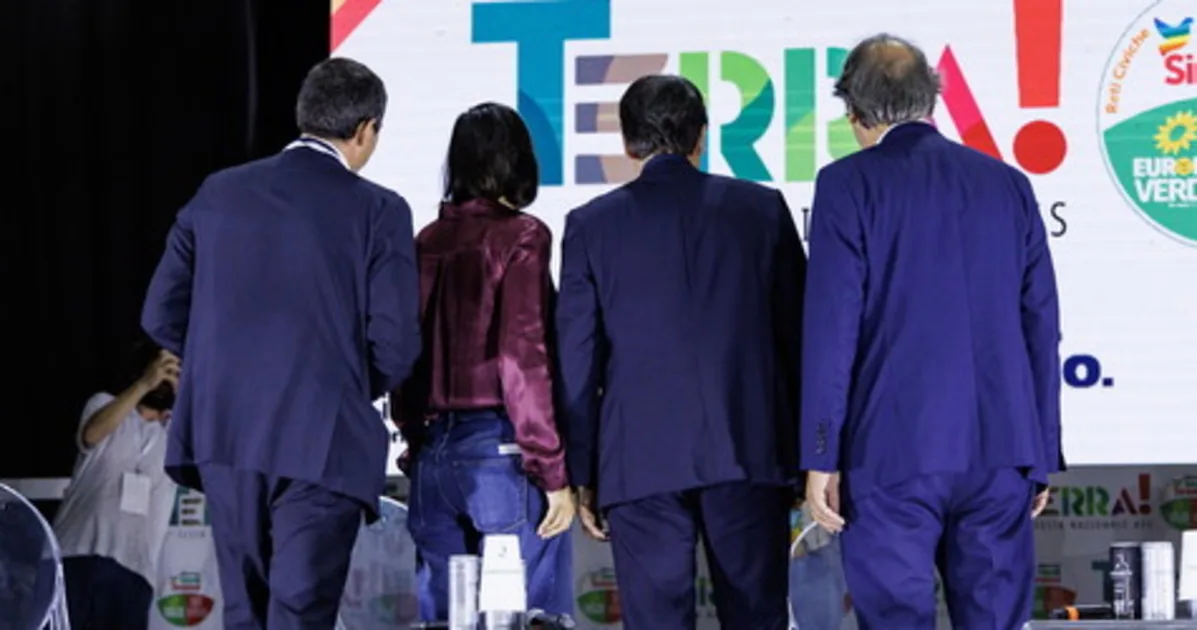





How can the inventor of the Jobs Act and Fratoianni be together? How is it possible that a reformist with strong Atlanticist and Europeanist traits forms a coalition with the Five Star Movement? It’s agreed that the left is thinking about a “broad field,” but to hold together such different things, you would need an entire plain… However, here we begin to understand more: a few evenings ago, on television, Matteo Renzi candidly admitted that the most important reason forcing him to be in an alliance with the Five Stars and with the Green-Left Alliance, from which he is worlds apart, is to form, in the new Parliament, a majority that can decisively influence the election of the next President of the Republic, scheduled for 2029.
Read more Migrants, Meloni: «Rules must be respected, here is who is being repatriated» | Libero Quotidiano.it
For heaven’s sake, nothing so new or strange, commentators have been repeating for months that the stakes in the upcoming political elections are not only the new parliamentary representation and the new government, but also the choice of the new Head of State. The debate then heated up when Giorgia Meloni said that a new right-wing President of the Republic would no longer be a taboo.
[[ge:kolumbus:liberoquotidiano:49102266]]
However, from how Renzi put it, there is something new and strange. As we know, the 2027 political elections have the immediate goal of renewing the representative Chambers, which must grant confidence to a new Government. This is what political elections are for, according to the Constitution: to periodically reactivate the democratic circuit, starting from the people to reach the executive power, passing through Parliament. Instead, Renzi’s statements suggest that they mainly serve to influence another, essential, game: the election of the new occupant of the Quirinale. A choice so decisive that it imposes otherwise unthinkable coalitions, which cheerfully ignore the political-cultural chasms dividing the world of reformist left from that of the Five Stars and AVS.
[[ge:kolumbus:liberoquotidiano:49095592]]
CALL TO ARMS
And the voters? Faced with these messages, they today undergo, in the electoral campaign that is beginning, a sort of immediate call to arms, to create a Parliament that, in 2029, (with the numerically not very significant contribution of regional delegates) can guarantee the achievement of the necessary majorities as needed (two-thirds of voters in the first three votes, absolute majority of those entitled from the fourth ballot). In short: differences are banned, the evidence of ideas and political cultures very distant from each other is overlooked: instead of a new and varied political representation, there is a phalanx united by the essential objective.
Read more Giorgia Meloni closes the door on him? Backstory: Vannacci loses his temper | Libero Quotidiano.it
It’s as if the coming Parliament must resemble a college of “great electors,” constituted specifically to choose the new President of the Republic, and to do only that, as happens in some form of presidential government. But let’s think carefully: this caricatural way of telling the new political elections has nothing to do with the current Constitution, indeed it constitutes an obvious distortion. And it is paradoxical that this happens precisely by those who rant, day after day, about the risk of an authoritarian drift wanted by the right, of the “woman alone in command” intolerant of democratic controls, and of an unconstitutional “de facto premiership” that would be prefigured by the new electoral law.
The reality is that precisely those who, in words, want to defend the Constitution from authoritarian threats, and who refer to the parliamentary Republic, present us with a sort of “de facto presidentialism,” which our Charter does not foresee at all. Let’s try to connect the dots, we will realize that the overall design presents surprising traits. On one hand, the practice of re-election for a second term of the last two Presidents of the Republic, in the silence of the Constitution, which neither forbids nor provides for it. The result is an office that can last fourteen years: I challenge you to find its equal, if we disregard Putin and some other autocrats. On the other hand, the crisis of parties and Parliament, which has clearly brought out, as Gaetano Quagliariello and Lorenzo Castellani write in their recent book, the new Prince, precisely the President of the Republic, on whom the very legitimacy of the system rests.
And now to complete the picture, we are told that in the political elections we must vote thinking especially about who will succeed Mattarella. But then: who betrays the Constitution? Who distorts it in this way, or who would have wanted to change it in canonical forms, perhaps to introduce a presidentialism not de facto but de jure?
[[ge:kolumbus:liberoquotidiano:49095414]]