

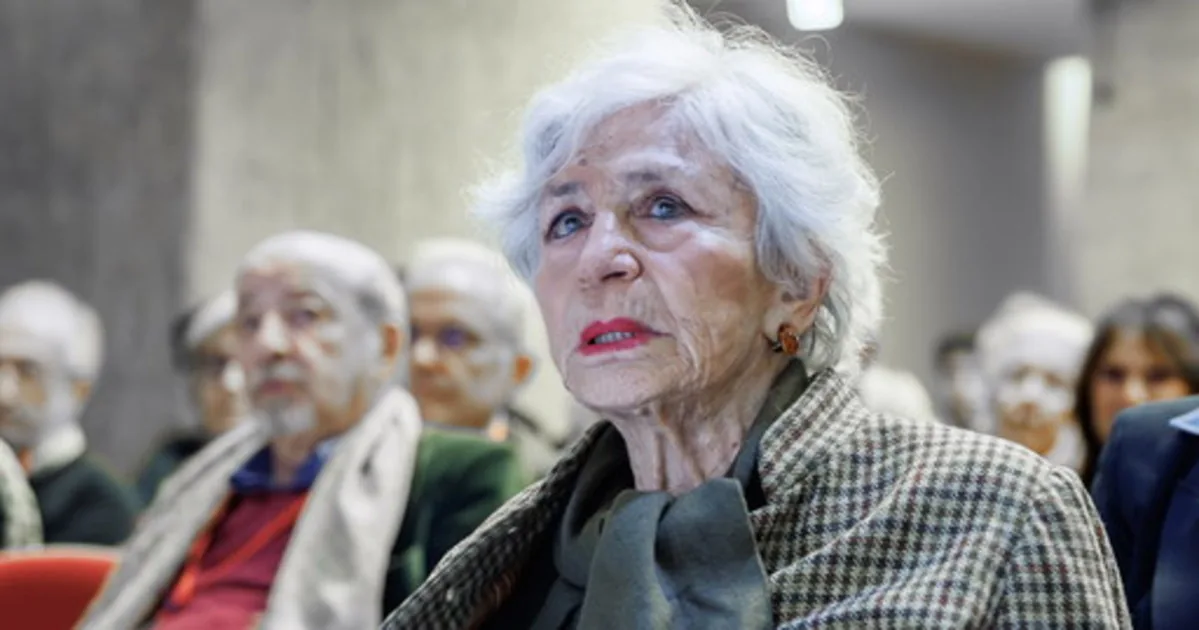
Luciana Castellina has spoken. She hadn’t done so for a long time. Not so much because of her age (97), but because, she says, she believes in politics done outside of parties, in civil society. In the interview granted to Adnkronos in Venice, where she is president of a jury for a short film award, the historic activist (she joined the PCI in 1947) stated that she cannot give up being a communist. And if nothing else, she deserves credit for not disguising herself as many do, who of the old church, which they say they no longer belong to, keep all the defects of intolerance and little or no democratic sense.
Read more Beppe Grillo, the post before the assault on Conte: general dismay | Libero Quotidiano.it
Castellina’s has always been, and continues to be, a romantic communism, firm in the belief that men can one day live on this earth, by political will, in an idyllic condition of peace and happiness, in a world of absolute justice and freedom. That this conquered human condition ends up resembling the bliss of sheep led to pasture, who have no drive to improve and progress, is an idea that certainly does not occur to Castellina.
But it is not only a matter of theory, but also of realism and the ability to learn from history. Communism is not only undesirable, but also unachievable: this is what the tragic story of the twentieth century tells us. It cannot continue to be conceived as a good idea badly realized if all attempts made in every part of the world have led to the same result: brutal dictatorships, widespread poverty, millions dead or imprisoned for their ideas or on the altar of five-year plans and rigid economic and political programs. Castellina’s is the stubbornness of a man of faith, of one who, blinded by ideology, does not want to see or understand the reality that flows before his eyes. “The Russian revolution,” she says, “brought equality, but it did not bring freedom, it took away freedom. And what do we do? Do we give up finding a society where there is freedom and also equality? I want to continue, I want to try.”
Read more The honorable who did not pay the escort: crazy buzz in Parliament | Libero Quotidiano.it
But is the communist leader really sure that equality was ever realized in the Soviet Union? Was the oligarchy in power really equal, in rights and privileges, to ordinary citizens? And what kind of equality is that in misery and lack of freedom? But it is useless to ask too many questions for those who have granite certainties and do not cultivate doubt. “We are facing an epochal historical change called the crisis of capitalism. It is not that capitalism has won.” The crisis of capitalism is a refrain of communist ideology. The question to ask is whether the crisis is not structural to this system which certainly has many defects but lives in crisis because it is the only one that has the ability to transform and amend itself. But Castellina is also “very optimistic”: more and more young people see her as she is and think that “the world must be changed, urgently.” A vast program, De Gaulle would say!
It is perhaps right that young people have it because, as Raymond Aron said, one is not a good liberal if one has not been a revolutionary when young. And in her own way, Castellina is an eternal young woman, and this can only inspire tenderness. “I laugh,” she adds, “when I think that Meloni finds it very interesting to be called conservative. What do they want to conserve of this world? There has never been so much injustice as today.” But isn’t a conservative perhaps someone who clings to failed ideas that history has dismantled in theory as in practice?