








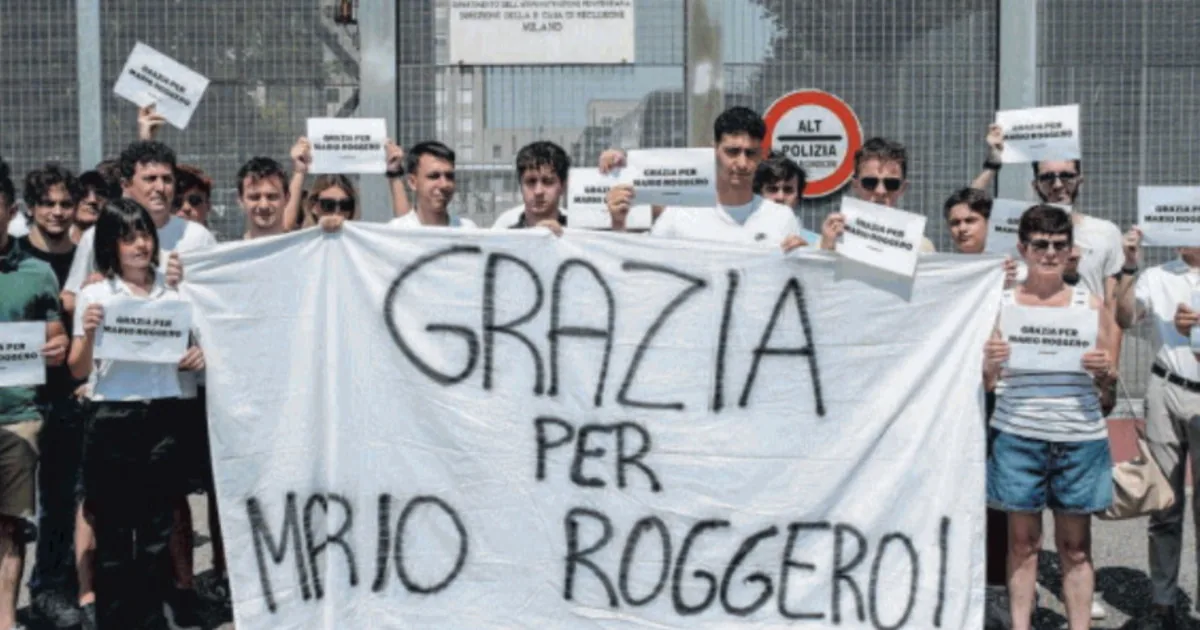
Many Italians stand with the jeweler because state protection has failed. Citizens are in solidarity with the goldsmith convicted by the Court of Cassation and believe it is necessary to defend themselves. It is the task of politics to restore trust in institutions, which entrust the monopoly of legitimate force to public authority.
Is it possible to reflect calmly, and not on the wave of emotion, on the Roggero case and all that it means? If so, there are some questions we must ask ourselves with great frankness, also seeking, with equal frankness, some answers. Why, then, do many Italians think that the jeweler from Grinzane Cavour did well to do what he did? Why do only a few believe that his was not an authentic legitimate defense against an actual and unjust aggression? Why do few, in the same way, think that he is responsible for a real double murder (even if, in the end, he shot two fleeing criminals in the back, even trying to finish off with a coup de grâce the one who was already gasping on the ground)? And why do always few seem to perceive a disvalue in taking someone’s life, if they have just tried to rob you, thus choosing the simplification of “he asked for it”?
Let’s set aside the explanations provided by little professors with perpetually raised fingers or by progressive sociologists in permanent service. Let’s also set aside the, albeit correct, clarifications coming from the category of jurists, to which I myself belong.
THE JURISTS
For us jurists, in fact, it is evident that it was not legitimate self-defense, and some of us argue that, at most, the various Tribunals and Courts that judged the case could only have inflicted on Roggero a sentence a few years shorter than that actually suffered, following procedures and reasonings that are not appropriate to revisit here.
But why, instead, are people who live normal lives, and are not sociologists or professors, instinctively not far, so to speak, from approving Roggero’s behavior? Reduced to its essence, I believe this is the issue.
To allow for the peaceful coexistence of a community of people, who recognize only one legitimate authority and confer upon it the necessary powers to guarantee order and security, a simple exchange must function: that between protection and obedience. You, public power, protect my life and that of my loved ones, my work and my trade. And precisely in exchange for this protection, I agree to respect the rules (laws) that you dictate, in the name of guaranteeing public peace. This exchange allows the monopoly of the legitimate use of force to be entrusted only to those who belong to public power, and thus not to allow self-justice. This, in essence, is what classical thinkers (the contractualists, Hobbes in the forefront) teach us, and this, in times close to us, was explained by a great figure of 20th-century Italian political science, Gianfranco Miglio. Political obligation, as he called it, rests on this simple exchange.
FEAR PREVAILS
Well. But what happens if this exchange seems to no longer work? If the perception of insecurity begins to dominate all of us, and if it is not mere or hysterical imagination, but rather what we see around us, in our neighborhoods, on the public transport we frequent? What happens is that fear prevails and we are led to think that we must defend ourselves, that therefore, in the face of an unjust aggression against our person and our property, defense is always legitimate and does not necessarily have to be proportionate to the offense we are receiving. In a word, that we can take justice into our own hands.
At this point, moralizing or scandalized pleas are of little use, often coming from those who live in contexts that allow them, in one way or another, not to have to confront the real lives of their peers.
Instead, what is needed is an awakening (alas, just as they said in the sixties…) based on an assumption as simple as that which underlies political obligation. As the classics of political thought have always taught, if one wants to avoid the civil war of all against all (Hobbes’s bellum omnium contra omnes), one must recognize that security is a fundamental right for everyone, and that policies that reasonably pursue it are not at all, as the dominant politically correct discourse tells us, the fruit of a mere instinct, or a hysterical, illiberal, and authoritarian attitude. Instead, they are the essential tool to restore to all of us the necessary trust in the pillars of the rule of law, which entrusts the monopoly of the legitimate use of force to public authority.
Read more Pagnoncelli Survey, numbers short circuit: fewer votes and one governs | Libero Quotidiano.it